History
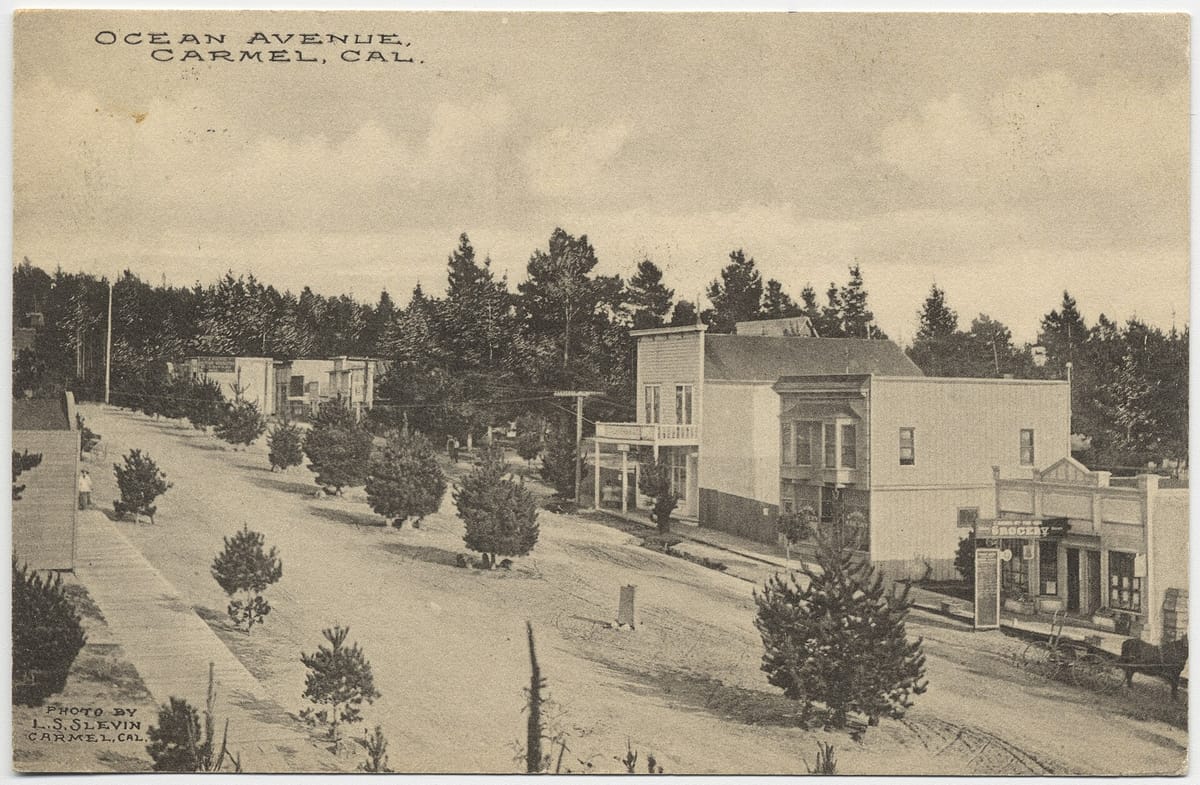
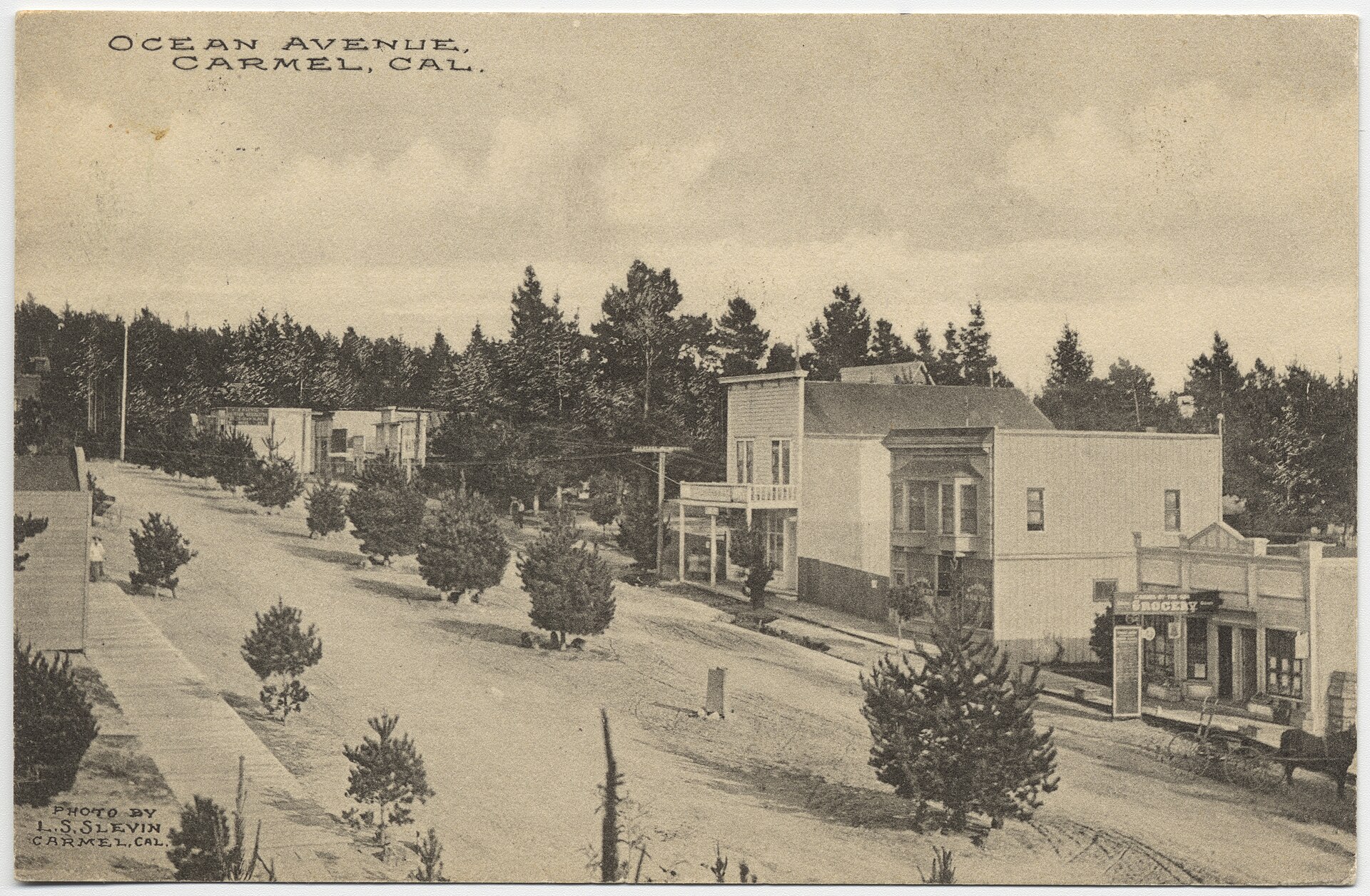
Carmel-by-the-Sea is a village of one square mile where a mission, a colony of poets and painters, a forest and a white-sand beach all came together. It took its name from a river, grew up around an old mission, and was laid out as a town in 1902.

A short history of Carmel-by-the-Sea
Carmel-by-the-Sea is a village of one square mile where a mission, a colony of poets and painters, a forest and a white-sand beach all came together. It took its name from a river, grew up around an old mission, and was laid out as a town in 1902. This page tells that story in short, with a link to the source for every claim. For the full texts of the old books, see the reading list.
The first people
Before the Spanish arrived, the Carmel River’s lower valley was home to the Rumsen Ohlone, and its upper reaches to the Esselen [3]. After the mission moved to the river in 1771, it stood close to the Rumsen villages of Tucutnut and Achasta [2]. A little to the south, at Point Lobos, a village called Ichxenta stood near San Jose Creek, and the evidence suggests people lived there for about 2,500 years [4].
Carmelite friars and a river, 1602
Spanish explorer Sebastián Vizcaíno landed at the mouth of the Carmel River in 1602 [1]. He probably named it Río Carmelo for the three Carmelite friars serving as chaplains on his voyage [1]. A cross on the beach at the river mouth marks the landing [19]. In 1769 the Portolá expedition camped on the same beach and rested there before deciding to turn back to San Diego [4] [19].
Serra’s mission
Father Junípero Serra founded Mission San Carlos Borromeo in Monterey on June 3, 1770 [2]. He wanted to put distance between the mission’s converts and the soldiers at the Presidio, and the river mouth offered better farmland, so the mission moved to Carmel in 1771 [2]. It was re-established on August 1, 1771, and Serra moved into the new buildings on December 24 [2]. For the next sixty years it was the headquarters of the whole chain of California missions [2].
The mission’s native laborers paid a heavy price. Disease, hunger and overwork cut the population from a peak of 876 or 927 in 1795 to 381 by 1823 [2]. Serra died on August 28, 1784, and was buried in the sanctuary beside Father Juan Crespí [1]. His successor, Fermín Lasuén, replaced the adobe church with a stone one [2].
Ruin and rescue
When Mexico secularized the missions in 1833 the Carmel mission was abandoned, and its roof fell in during 1852 [2]. A county history of 1881 called it “the old Westminister Abbey of the State” and urged the church to restore it [22]. Father Angel Casanova raised enough money to put a new roof on the chapel in 1884 [2]. In 1931 the cabinetmaker Harry Downie began a restoration that lasted about fifty years [2]. The church became a minor basilica in 1960, and Pope John Paul II visited in 1987 [2].
Ranchos and a first subdivision
In the 1850s a French businessman, Honoré Escolle, bought Rancho Las Manzanitas, the land that would become Carmel-by-the-Sea [1]. John Martin bought land along the river in 1859, and his dairy and farm became known as Mission Ranch [1]. In 1888 Escolle and Santiago J. Duckworth filed a subdivision map, and by 1889 about 200 lots had sold [1]. A promotional postcard by Abbie Jane Hunter first used the name “Carmel-by-the-Sea” [1].
Devendorf, Powers and the artists, 1902-1916
In 1902 James Franklin Devendorf and Frank Hubbard Powers filed a map of the core village on behalf of the Carmel Development Company [1]. A local builder, Michael J. Murphy, put up nearly 350 buildings between 1902 and 1940 [1]. A 1925 book by two Carmel writers remembered that word got out that here were beauty and quiet, and that “brother artists” came visiting, stayed, and sent for their typewriters and easels [15].
The Carmel Arts and Crafts Club formed in 1905, and poet George Sterling and writer Mary Austin both settled that year [1] [11]. After the 1906 San Francisco earthquake more artists, writers and musicians arrived, and newcomers were offered lots for ten dollars down [1].
A theater in the woods
In 1910 Herbert Heron asked Devendorf for land for an outdoor theater, and Devendorf let the group use a hollow in the pines for free [5]. The Forest Theater opened on July 9, 1910, with a biblical drama called David [5]. Shakespeare followed in 1911 with Twelfth Night [5]. Mary Austin’s play Fire premiered there in 1913, and she is credited with suggesting an outdoor stage [1]. In 1915 a Carmel pageant about Serra was performed at the Panama-Pacific Exposition in San Francisco [1]. On July 4, 1911, townspeople had already staged a pageant at the mission about its founding [17].
A village of its own, 1916 onward
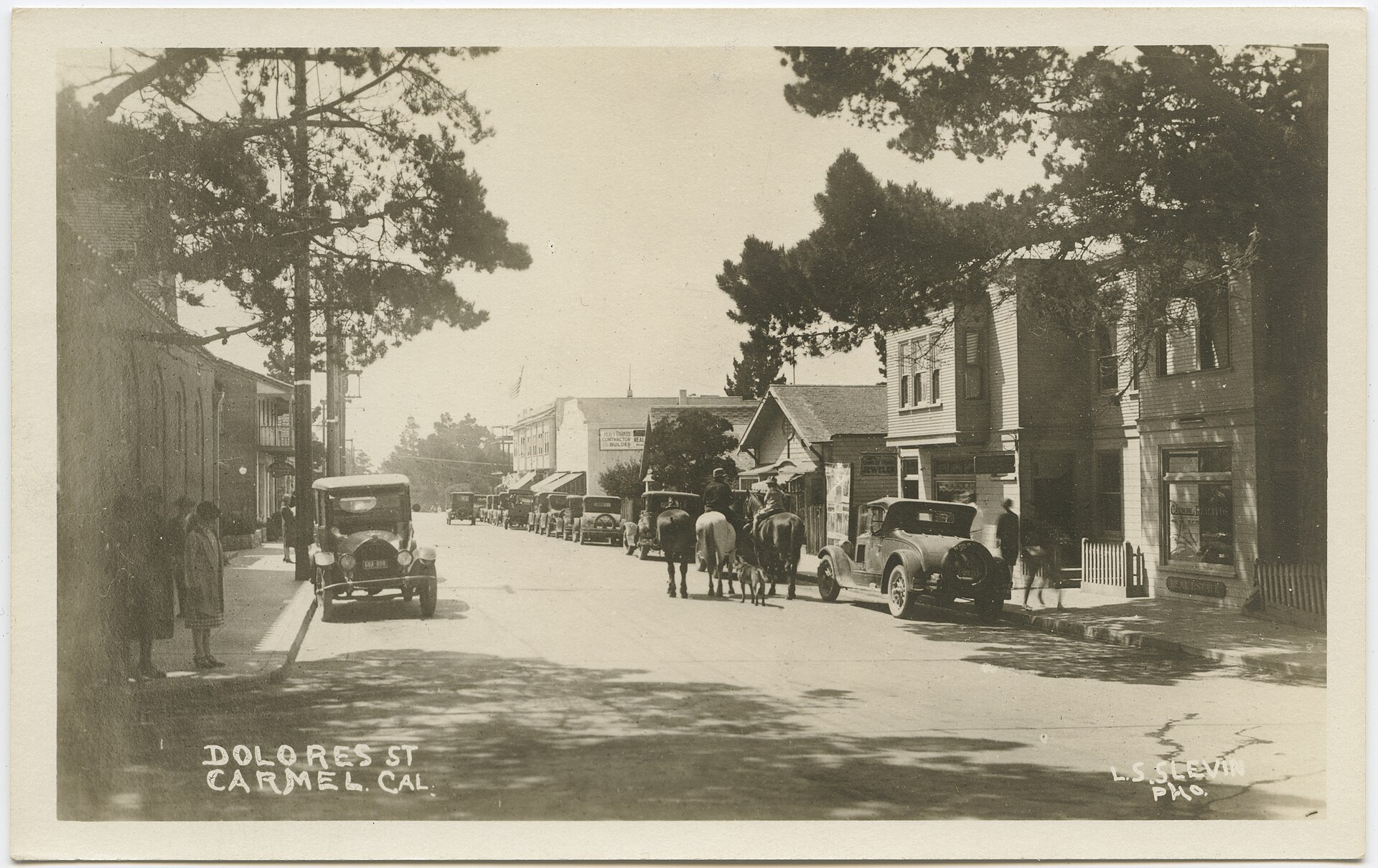
Carmel incorporated in 1916 [1]; one account gives the date as October 31 [20]. The weekly Carmel Pine Cone has been printed since 1915 [1]. By 1926 a Monterey historian described a place defined by “individual freedom,” with almost no crime and a police force of one man and one horse [16]. Residents left empty milk bottles on little shelves called milk shrines, played Sunday baseball in the Abalone League and stopped by the post office three times a day for mail [15] [16].
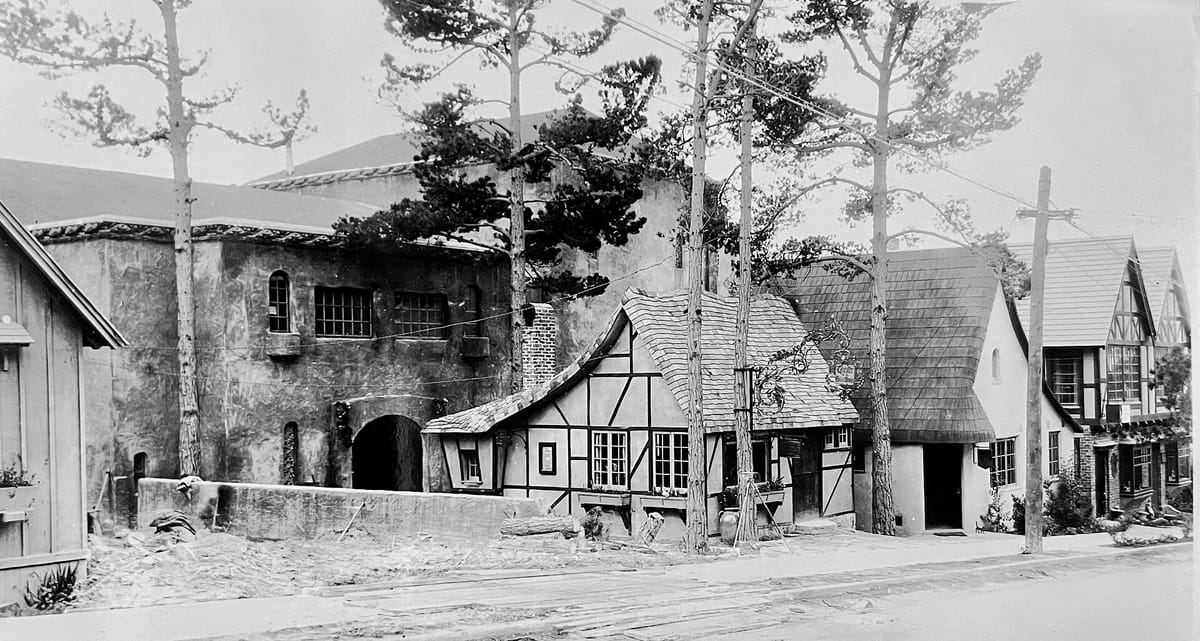
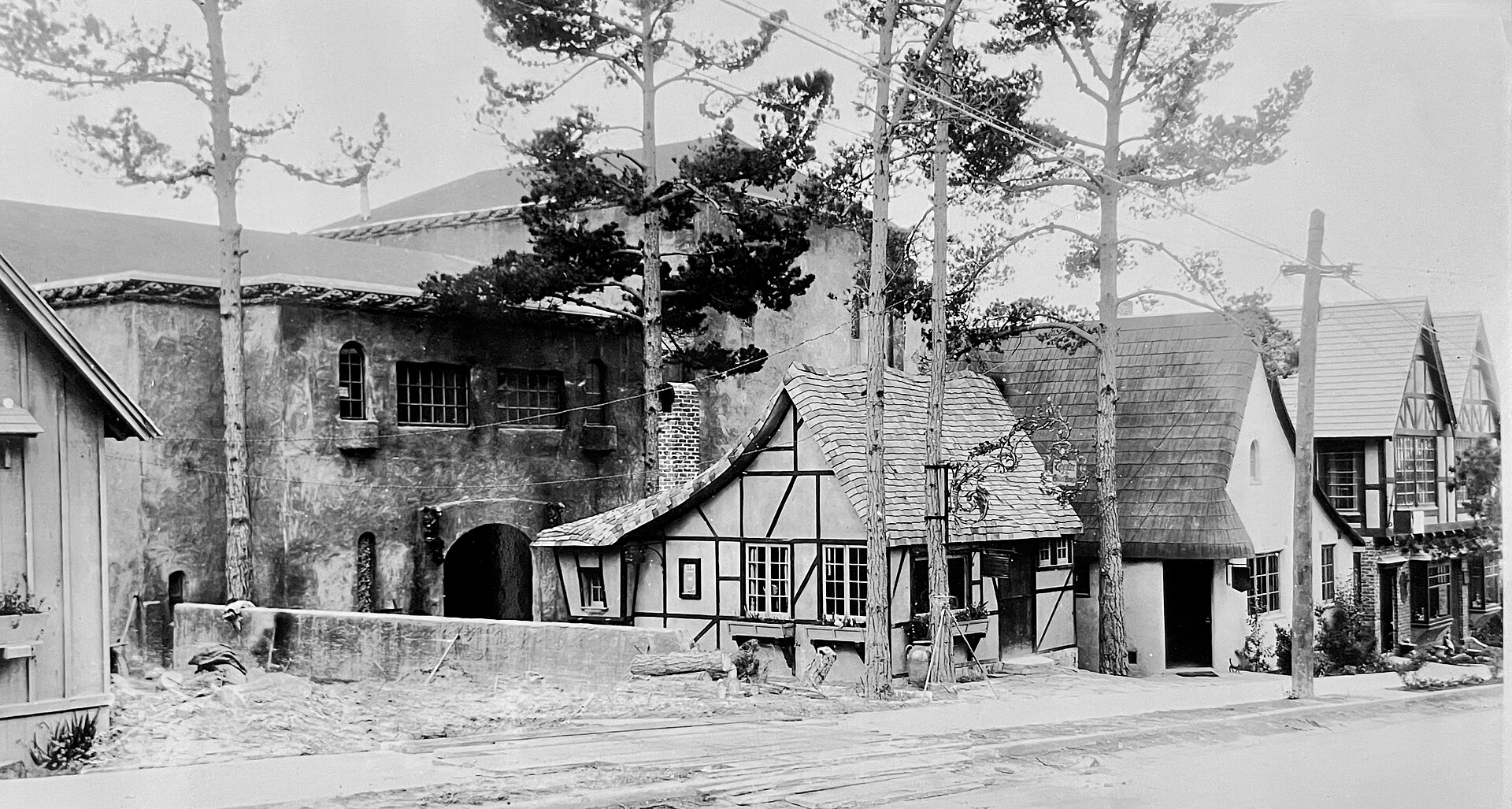
Builder Hugh Comstock completed the Hansel cottage in 1924, the first of the fairytale-style buildings that give the village its look [18]. The city adopted a 1929 ordinance that kept residential streets free of sidewalks, street lights and street addresses [12]. City attorney Argyll Campbell wrote many of Carmel’s first zoning rules, which also limited building height and kept out chain restaurants and billboards [1].
Poets, painters and musicians
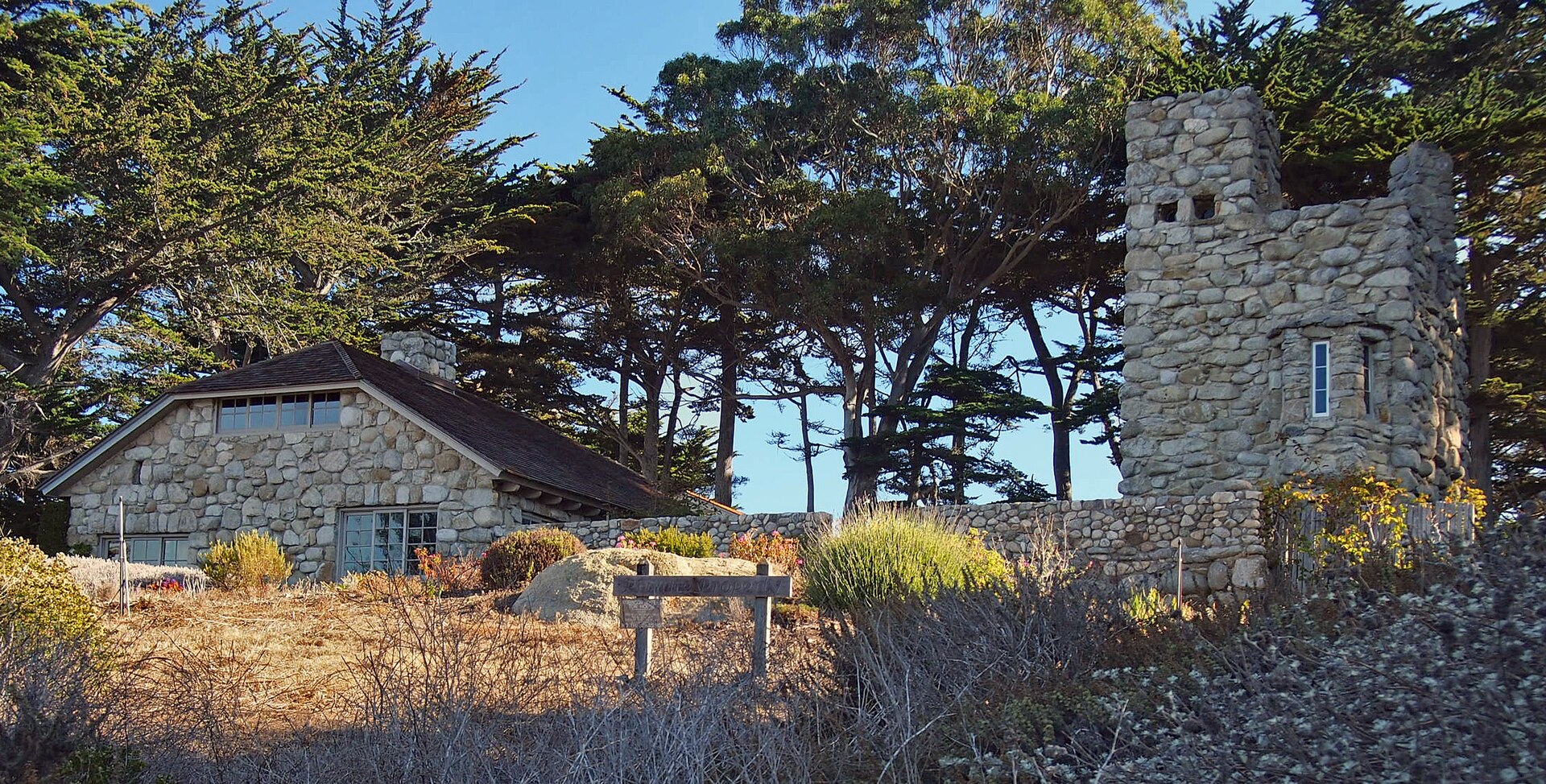
Robinson and Una Jeffers settled in Carmel in 1914 [9]. Between 1919 and 1924 Robinson built Tor House and Hawk Tower from boulders hauled up from the beach [8], and he wrote all his major poems there [8]. Tor House was named a National Historic Landmark in 2024 [8].
The Carmel Art Association was founded on August 8, 1927, and is the village’s oldest gallery [6]. Photographer Edward Weston moved to Carmel in 1929 and made many of his best-known nature photographs at Point Lobos [1]. Ansel Adams settled in Carmel Highlands in 1962 [1]. The Carmel Bach Festival began in 1935 as a four-day series of concerts at the Sunset School Auditorium and the mission basilica, and for more than eighty years its home has been Sunset Center [7].
Point Lobos and the coast
South of the village, Point Lobos was once a Chinese fishing camp, a Portuguese whaling station, a granite quarry and a coal-and-sand operation [4]. A company even subdivided it into 1,000 lots as “Carmelito” in the 1890s, but engineer Alexander Allan bought most of them back [4]. His family sold the land to California in 1933, three years after his death [1] [4]. Carmel Highlands, just south of the reserve, was laid out in 1916 by Devendorf and Powers [21].
A mayor and an ice cream cone
In April 1986 actor Clint Eastwood was elected mayor, beating the incumbent Charlotte Townsend 2,166 votes to 799 [14]. He had run after a dispute with the city council over his plans to build on land he owned in town [14]. The “ice cream cone ban” of local legend was really a mix of takeout-food and water rules, and in August 1986 the council passed an ordinance setting standards for ice cream parlors [13]. Eastwood gave his $200 monthly salary to a local youth center [14].
Today
About 3,220 people lived in Carmel at the 2020 census [1]. The village still has no street lights, parking meters or traffic lights, and its buildings must be built around existing trees [1]. For more than a century it also had no street addresses; in July 2024 the council voted 3-2 to give houses numbers, and in October 2025 approved a plan to begin assigning them [1] [12]. There is still no mail delivery to homes [1].
Key dates
01
1602
Vizcaino lands
Sebastian Vizcaino comes ashore on the beach at the mouth of the Carmel River. Source ↗
02
1771
The mission moves to Carmel
Founded at Monterey in 1770, Mission San Carlos Borromeo is re-established at the mouth of the Carmel River on 1 August. Source ↗
03
1784
Serra dies
Junipero Serra dies on 28 August and is buried beneath the chapel floor at his own request. Source ↗
04
1797
The stone church
The stone basilica that replaced the adobe church, begun under Fermin Lasuen, is dated to 1797. Source ↗
05
1902
A village on paper
Frank Powers and James Devendorf found the Carmel Development Company and file a map of the village. Source ↗
06
1910
The Forest Theater opens
The first performance in the open-air theater is David and Saul, on 9 July. Source ↗
07
1916
A city
Carmel-by-the-Sea incorporates on 31 October. Source ↗
08
1919
Tor House
Robinson Jeffers begins building his stone house on Carmel Point, and Hawk Tower follows from 1920. Source ↗
09
1924
Hansel and the Golden Bough
Hugh Comstock builds the first storybook cottage, and Edward Kuster opens the Theatre of the Golden Bough. Source ↗
10
1927
The Carmel Art Association
Artists found the association on 8 August, and 41 artists exhibit together that October. Source ↗
11
1933
Point Lobos goes public
The Allan family sells 348 acres of the point to the State of California. Source ↗
12
1935
The Bach Festival
The first Carmel Bach Festival begins as a few days of open rehearsals and concerts. Source ↗
13
1986
Mayor Eastwood
Actor Clint Eastwood is elected mayor and serves one term, to 1988. Source ↗
14
2024
Tor House a National Historic Landmark
Jeffers’s stone house and Hawk Tower are designated on 13 December. Source ↗
Sources
1. Carmel-by-the-Sea, California — Wikipedia
2. Mission San Carlos Borromeo de Carmelo — Wikipedia
3. Carmel River (California) — Wikipedia
4. Point Lobos State Natural Reserve — Wikipedia
6. Carmel Art Association — Wikipedia
7. History of the Carmel Bach Festival — Carmel Bach Festival
9. Robinson Jeffers — Wikipedia
10. Mary Hunter Austin — Wikipedia
11. George Sterling — Wikipedia
13. The True Story of Carmel’s Ice Cream Cone Controversy — Monterey County Weekly, 2022
14. When Clint Eastwood Was Elected Mayor of Carmel, California — Mental Floss, 2016
15. Carmel—At Work and Play (Bostick & Castelhun, 1925) — Internet Archive
16. Dawn and the Dons: The Romance of Monterey (Tirey L. Ford, 1926) — Internet Archive
17. Guide Book to the Mission of San Carlos at Carmel and Monterey (Slevin, 1912) — Internet Archive
18. Carmel-by-the-Sea Fairytale Cottages Walking Tour — Visit Carmel-by-the-Sea
19. Carmel River State Beach — Wikipedia
20. Wanderings: Carmel-by-the-Sea, California — Western Art & Architecture, 2016
21. Carmel Highlands, California — Wikipedia
22. History of Monterey County, California (Elliott & Moore, 1881) — Internet Archive
Further reading
Carmel—At Work and Play, Daisy F. Bostick, Dorothea Castelhun (1925) — public domain, free to read online
Dawn and the Dons: The Romance of Monterey, Tirey L. Ford (1926) — public domain, free to read online
History of Monterey County, California, with Illustrations Descriptive of Its Scenery, Residences, Fine Blocks and Manufactories, Elliott & Moore (publishers) (1881) — public domain, free to read online
Monterey County, California: Souvenir Edition, Arthur Dunn (1915) — public domain, free to read online
The Hand Book to Monterey and Vicinity, Unnamed compiler (1875) — public domain, free to read online
Guide Book to the Mission of San Carlos at Carmel and Monterey, L. S. Slevin, M. E. Slevin (1912) — public domain, free to read online
The Cypress of Monterey: An Historical Sketch, Estella L. Guppy (1925) — public domain, free to read online
Roan Stallion, Tamar and Other Poems, Robinson Jeffers (1925) — borrow it from the Internet Archive
Californians, Robinson Jeffers (1916)
Cawdor and Other Poems, Robinson Jeffers (1928) — borrow it from the Internet Archive
A Wine of Wizardry, and Other Poems, George Sterling (1909)
Flagons and Apples, Robinson Jeffers (1912) — borrow it from the Internet Archive
History and Biographical Record of Monterey and San Benito Counties, J. M. Guinn (1910)
Pebble Beach, Monterey County, California, A. D. Shepard (1909)
The Padre’s Little Caretaker: A Romance of the Carmel Mission, Sarah Ritchie Heath (1913)
The Carmel Pine Cone (digitized issues, 1915-1930), Pine Cone Press (1915)
Carmel Cymbal (digitized issues, 1926-1927), The Cymbal Press (1926)
History of Carmel (1542-1966), Marjory Lloyd (1966) — borrow it from the Internet Archive
Yesterday’s Artists on the Monterey Peninsula, Helen Spangenberg (1976) — borrow it from the Internet Archive
Carmel-by-the-Sea: Yesterday, Today and Tomorrow, Herbert B. Blanks (1965) — borrow it from the Internet Archive